
Help
How to read the result
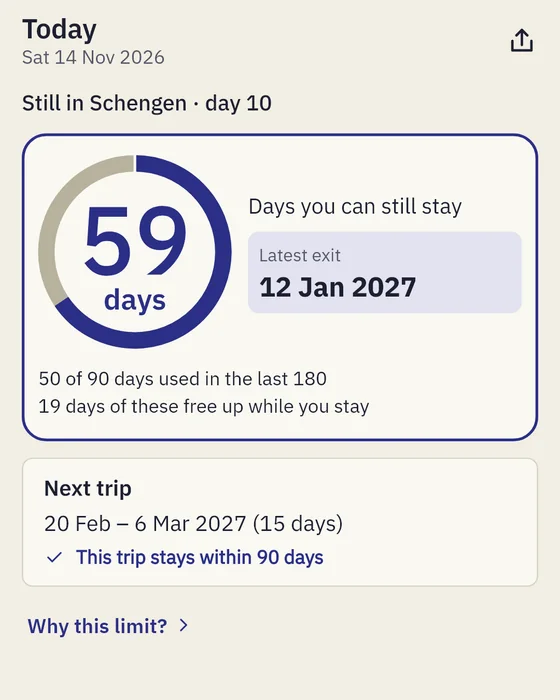
- Days used: days you were in the Schengen area in the 180 days ending on the date you check. Entry and exit days count as full days.
- Days left: 90 minus days used, on that date. This is not the same as how long you can stay.
- Leave-by date (if you are in Schengen now): the last day you can be there on this stay. It already includes the days that free up while you stay, so it can be later than "days left" suggests.
- Days freed up in the next 30 days: older days that leave the 180-day window and can be used again.
- Earliest entry (if you have no days left): the first date you can enter for at least one day.
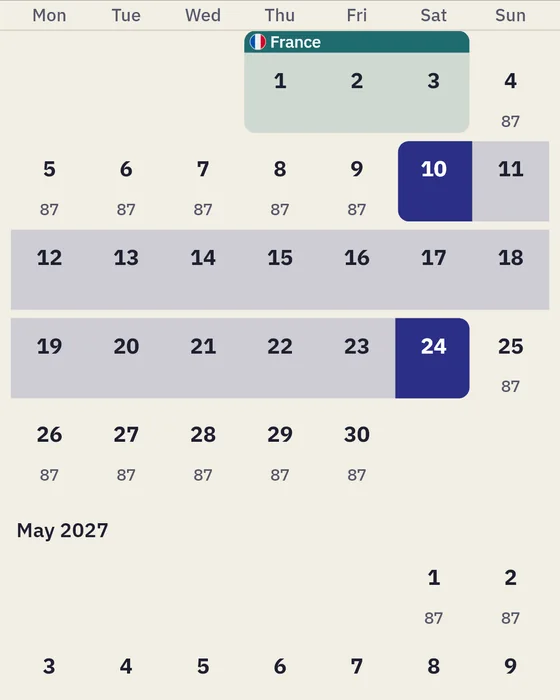
- Planned trip: "fits" if the count stays at 90 or below on every day of the trip; otherwise the first day it would go over and by how many days.
Example: on 17 Nov 2026 you have been in Schengen 1–30 Jun, 1–30 Sep and since 1 Nov. Days used: 77. Days left: 13. But the 30 June days stop counting one by one from 28 Nov, so you can stay until 30 Dec: 43 more days, not 13.
What the calculator assumes
- You are not an EU, EEA or Swiss citizen and you are on short stays (no visa, or a short-stay visa).
- Only the 29 Schengen countries count. Do not enter trips to Ireland, Cyprus, the UK or other non-Schengen countries.
- Days covered by a long-stay (D) visa or residence permit do not count; leave them out.
- A short-stay visa can allow fewer than 90 days and has its own dates. Bilateral agreements can allow extra days in one country. Brazilian ordinary passports follow a different count. These cases are not calculated.
This estimates your stay under the Schengen 90/180-day rule from the dates you enter. It is not legal advice and not an official record. Border authorities and the EU Entry/Exit System (EES) decide your authorised stay; special agreements, visas and permits can change it. What you enter is kept only in this browser on your device and is never sent anywhere.